
When somebody accidentally smokes the lucky upside-down cigarette in your pack of Camel Turkish Golds and you start to feel the bad luck take its reign, there might only be one solution: drive to downtown 6th street and eat a green grape whilst chanting, ‘The curse is lifted,’ three times. You might then score a collaborative interview/photoshoot you and your friend were only dreaming of one week prior. Thank you Julian, I’ll cheers a green grape to you anytime.
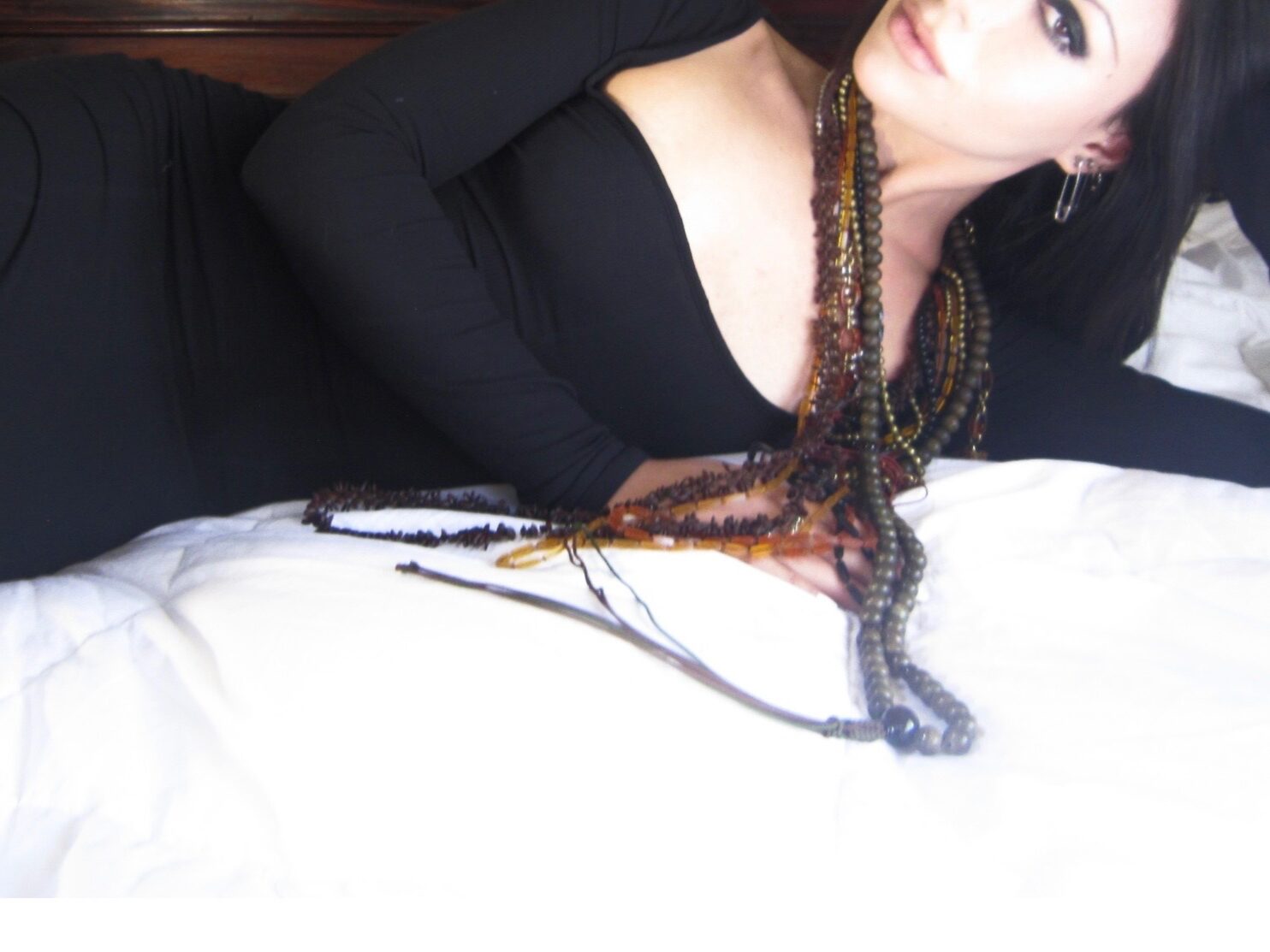
Outside Hole in the Wall’s bustling unofficial South by Southwest showcase, I find a desolate corner bench to meet the one and only Taraneh, a New York based alternative rockstar. She’s a fresh echo of early 2000’s goth rock with grit-heavy, emotionally serrated vocals carried by brooding rock instrumentations.
Flip the first cigarette in your fresh pack. Eat the green grape.
Rockstars are women.
And, somehow, we’ve been invited inside her mind.

How has your unofficial South by Southwest experience been?
It’s been great. It’s our first South by Southwest experience. It’s kind of nuts doing nine shows in four days, but it’s been a real blast. I’m very grateful that we’ve been able to play and share our music with Austin and experience the city through the perspective of playing nine shows. That’s the best way to experience the city, meet people, and see what it’s all about.
Are you exhausted by the end of it?
I’m a little exhausted, but this is what I love doing, so it fuels me and keeps me going. We’ve been on tour for three and a half weeks prior to this week at South by Southwest, so I think it’s a cumulative exhaustion in a way that catches up to you inevitably. I definitely do my fair share of things to keep up with the madness.
Have you had a favorite spot that you’ve played since you’ve been here?
Oh, gosh, all the places are blending together. We did an official showcase at Hotel Vegas. I don’t know what saying you’re an official South by Southwest artist is worth in 2026, but it was really fun playing that. I loved all the Co-ops that we played, too. The kids really turned out and turned up, which is a really good vibe, so I’m grateful that we had a chance to share the music with people who like listening to music, because I think that’s sometimes rare.
The people at the Co-ops are not afraid of moshing…
New Guild, that was a great show. That was really fun. The tree house one was fun too. Most of these days, we’ve been playing three shows a day, though, so it’s blending together, but they’ve all been great. There wasn’t a single place that I didn’t like.

Did you notice any difference between playing an official show compared to the unofficial shows?
The age difference is what I noticed the most. It’s a much older crowd for the official showcases. It’s definitely different playing to a 30-plus crowd than to a 25-and-under crowd. I pull out a different set of energetic approaches when I’m faced with the two.
How do you think that Austin compares to where you’re from in New York?
It’s pretty different, honestly. It’s the same in the sense that people are there to enjoy the music and to wake it up. The references and the taste-making are a little bit different, but it’s also similar in that we’re all here for the same reason. It’s a different geographical setting, and the city’s laid out differently, and I think that inherently contributes to different crowds and different audiences. But to say that it’s wildly different is an overstatement, for sure. There are definitely some cohesive threads throughout.
I read that you were an investigative journalist, and I think that is so cool. Was there a moment when you were doing investigative reporting that you really realized you’d rather be doing music full-time?
I think the switch to doing music entirely was very organic. The whole time that I was an investigative journalist, I was still releasing music, writing music and playing shows. There was this one moment where I felt entirely guided to leave the former behind to pursue the latter, the latter being music, and it was just one of those moments where I trusted my intuition. I jumped, and the universe caught me in this very beautiful way.

Is there anything that you’re hoping to get out of being a full-time musician that you weren’t getting while doing both?
I would say that being a musician, especially in this day and age, is very much walking and forging your own path. There’s not really this pre-written, predisposed path to walk as an artist. Back in the day, you would get signed to a label, and your success was based on the number of CDs you would sell. There was this very formulaic approach to being a successful musician. Whereas now I think it requires a little bit more blind faith and trust in yourself, your passion and the world around you. Journalism, you get a job, and you write for a newspaper, or you freelance, and there’s this very measurable set of steps that you can take to achieve success in that path. Music definitely takes, again, that blind faith in yourself, your abilities and in the universe. And obviously, as a musician, you’re able to express yourself in a way that you’re not as a journalist. Journalism is formulaic in the sense that there are certain rules that you follow. There are certain objectives, and there are objectives in music as well, but I think it’s a little bit more customizable. You can build your own world, whereas as a journalist, at least the kind of journalism that I was doing, you’re navigating within a certain set of sometimes rigid parameters, which have their benefits. I believe in journalism as an institution, and I still apply the skills that I learned as a journalist in my everyday life. It’s not something that I’ll ever totally abandon. Hey, maybe there’ll be a day when I return to it in some capacity. But for now, music is where my heart and soul have guided me, so here we are.
Whenever you made the decision, did you have any pushback from your family or from your friends?
The biggest obstacle for me to overcome was my own associations with the prestige of being a journalist. I climbed the ranks of my field fairly quickly, and I’m very grateful that I had the opportunities to do so. I was 22, 23 years old, and I had already been a fellow at some of the most prestigious journalistic institutions in the United States, so to achieve those things and get to the point that I did and then walk away, I think it took a lot of releasing my own expectations for myself and honoring and releasing my own measures that made me proud of myself in the context of being a journalist. It feels good for people to look at you and be like, ‘Oh, wow, you did all of those things. That’s amazing,’ and to then be able to release that and be like, ‘I’m gonna give myself my own, ‘Oh, wow.’’
Have you ever felt challenged being a female artist in this industry?
All the time, honestly. It’s funny how the things that Courtney Love and Kim Gordon wrote about in their own memoirs from 30 years ago still track to this day. It just comes with the territory. There’s immense power in being a female artist, and that’s something a lot of male artists can’t square for themselves. It can be threatening, and it can be upsetting, and it can trigger a lot of pushback, I think. I’ve been pretty lucky in the sense that my band is all men and they’re very supportive and respectful of me. As a woman, I feel very lucky that I’ve found the right people. But I’ve talked to my fair share of sound guys who sniffed down their nose at me ‘cause I’m a woman, and they definitely shake my hand after the set, but it’s not without a little fight before. And whenever a video is flooded with hate comments like on the Audiotree I did recently, I’ll click on those profiles to discover they’re all middle aged men trying to pit me against other female musicians saying ‘you should sing more like this girl’ or ‘look at this female fronted band, this is what a female fronted band should look like.’ Feeling like you have to prove yourself as a female artist is something that I’ve had to make peace with and release a lot, where I’ve gotten to the point where I’m not gonna feel like I have to prove myself. That energy really does shift things, but it took me a while to get there and to recognize that. It’s 2026, you don’t want to think that varying degrees of misogyny are factoring in these days, but they inherently do. A lot of people will say we’ve come so far as society so there’s no way that there’s misogyny in the workplace and in any industry, and yes, we have come so far but I think now we’re down to brass tacks in the sense that sometimes it’s subtle but then again, sometimes it’s not.

I asked a band I interviewed a while back the same question, and their response was, ‘Why do we have to be labeled a girl band? Why can’t we just be a band?’
I honestly think being a girl band is cool in and of itself. I don’t think, at least from my perspective, labeling a band of all women ‘a girl band’ is a bad thing. It’s a cool thing. I feel like there’s a bigger issue with a culture that makes us feel ashamed of being labeled girls. When dudes say it’s a girl band maybe they’re looking down on the group. But when I hear ‘girl band,’ I’m like, ‘that’s sick,’ you know?
I do want to talk about the album that you released in October. How do you think your spiritual background and your Iranian background fit into the complexity of the album?
My identity always factors into the work that I create. It inherently shapes my perspective in a way that’s inextricably tied to what I make. Being Iranian is inherently part of that. Being spiritual is inherently part of that. Unobsession, in a different, unique way, was a synthesis of a deeply personal process, in a sense. It very much encapsulates the year in which I wrote it. My past albums feel a little bit more amorphous in the sense that they’re a little bit more widely applicable to my experience, at least at this point post-release. With Unobsession, I hear the songs, and I pinpoint exactly what the lyrics are reflecting. I’d never really experienced this before, but it was difficult for me to listen to the album when we released it. It was so fresh, and it was so emotional. My other albums drew from years of experiences, but Unobsession was very much tied to a specific place and time. I’m just now getting to a point where I listen to the album, and it doesn’t feel so raw, and it doesn’t feel so fresh and immediate.
Did you have a specific vision or concept in mind for the album from the beginning, or was it something that evolved over time as you worked on it?
This is the first album that I wrote with my band, so it’s interesting because I think that’s very much part of the subject matter and the process. It immediately stemmed from us augmenting my old songs for our live sets on tour. We came back from tour, and we started writing this album.
How has the rollout of the album, performing and such, been for you?
It’s been great. It’s a huge blessing to be able to tour. As taxing as it can be, it is one of the most rewarding things as an artist to be able to share your music with the world, and that is what touring is. Not only that, but to also connect with your bandmates and bring the work to life in a new way. The recordings are their own thing, but being able to play the songs and seeing how they evolve over the course of a tour, also, has been very special. That’s something that I’ve definitely been able to witness in real time.

What new music or projects are you working on now? If you are at all.
I’m working on a number of singles that blend the new sound with the band with my old solo sound. I feel like it’s a little too soon for me to do another album, but it’s definitely on the horizon, within the next year and a half. We wrote the album as a band, and then we toured off of it, and we’re still touring off of it. I’m at this point where I’m ready to live life a little bit more. I need some new experiences. I need to live a little bit more life before I feel ready to digest it into songs and into the subject matter. After the last album, I was like, ‘Okay, what’s the next thing?’ And I was like, ‘Tara, slow down. It’s time to live a little bit.’”
Have there been any new bands or artists or creative things in general that have been inspiring you?
When the Kite String Pops by Acid Bath and Thirteenth Step by A Perfect Circle were two of the biggest influences for Unobsession. We listened to those albums incessantly on tour in 2024 and I feel like they rewired my brain in this beautiful way that really inspired and pushed the sound in a new direction. Some of my eternal favorites that influence everything I do are Kourosh Yaghmaei, father of pre-revolution psychedelic rock, Melvins Houdini and Sufism (Shams Tabrizi, Attar Conference of The Birds). New Age mysticism and religion in general. Dream analysis and universal symbolism.
What do you hope that this next year looks like for you as an artist?
I’m really looking forward to touring as much as possible, and again, experiencing life and finding joy in every day. I’m looking forward to exploring new routes and breaking down some of the walls that I’ve created for myself. It’s inherent to create walls for yourself, but I’m looking forward to challenging some of my notions that I’ve picked up in the last year, about myself and about what being an artist is.

I was interviewing Comet, and she said that you, her and Cristina were doing a monthly show in New York. Can you tell me more about that?
We all started this new monthly show series called Glue. The whole objective is to create a unified rock scene in New York, very community-based, very music-based. New York, especially the music scene, is very fragmented. Electronic music has reigned supreme in New York- and maybe in the U.S., maybe in the world- for the last few years, and Comet and I being women who make rock music, obviously, we have our own stake in things to wake up the rock scene. Cristina balances everything really well because she just gets it, not to mention that she’s a legendary promoter and booking agent. Creating a free, monthly show series is our way of unifying the sound and unifying the scene in a way that I think is already benefiting the current cultural moment. Even on a smaller level for our friends and us, it’s nice to create something that’s accessible, and that brings good music to the people in this way—the people being us as well. It’s an opportunity for us to showcase our friends and to showcase music that we love in a way that everyone can experience. We picked this bar in Ridgewood called Bar Freda to be the center point of the show, so we hope to create a community home base where people can come and be sure to find the best music every month and have a great time.